Contamination Control
Contamination Is Costing Your Equipment More Than You Think
Dirt, water, and poor lubricant handling can reduce oil life, accelerate component wear, increase downtime, and shorten equipment life.

DRY. CLEAN. RELIABLE.™
How Contamination Impacts Equipment
Accelerated Wear
Particles create abrasion and fatigue that shorten component life.
Higher Maintenance Costs
Contamination increases repairs, replacements, oil changes, and troubleshooting.
Moisture Damage
Water contributes to corrosion, oxidation, additive depletion, and reduced film strength.
Unplanned Downtime
Poor oil cleanliness increases the risk of unexpected equipment failure.
What Is Lubricant Contamination?
Contamination occurs when unwanted materials enter or develop inside a lubricant or hydraulic fluid. These contaminants compromise lubricant performance and increase the risk of equipment failure.
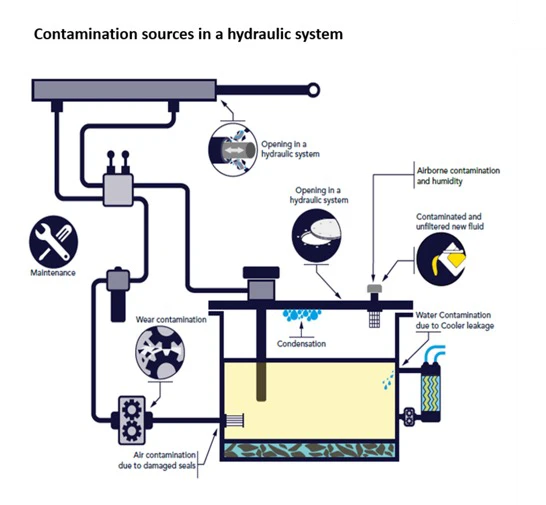
The Four Sources of Contamination
New Fluid
Oil can arrive with particle levels that are not suitable without proper filtration.
Dirty Components
Hoses, reservoirs, transfer containers, and system parts can introduce contamination.
Ingressed
Dirt, dust, moisture, and airborne particles enter through vents, seals, ports, and handling.
Internal Wear
Operating equipment naturally creates wear debris that can circulate and cause more damage
Contamination control must begin before the lubricant ever reaches the equipment.
Water – One of the Most Damaging Contaminants
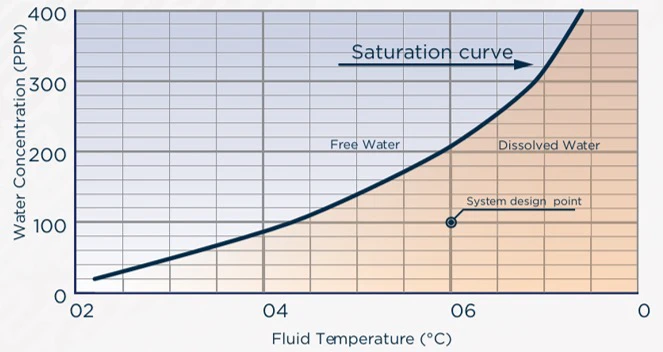
Water in hydraulic and lubricating oils is a major contaminant that can cause serious equipment damage and reduced lubricant performance. It can enter the system through condensation, leaks, or improper storage. Even small amounts of water can lead to oxidation, corrosion, reduced load-carrying capacity, and increased wear due to loss of film strength.
Water contamination can exist in three forms:
Dissolved
(invisible at low concentrations)
Emulsified
(milky appearance)
Free water
(separates at the bottom)
Effective filtration, dehydration, and proper oil storage are essential to minimizing water contamination and maintaining optimal equipment performance. The water concentration in a hydraulic fluid is marked as RH percentage (relative humidity), ppm (parts per million) or % (percentage weight or volume). Most common saturation points will be between 200 and 600 ppm (0,02– 0,06 percent) depending on the temperature of the oil. At a higher temperature the oil will be able to hold more water. Water also becomes harder to manage as operating conditions change. Temperature, humidity, washdowns, outdoor environments, and frequent reservoir breathing can all increase moisture exposure and condensation risk.
Each form creates reliability risk.
Water contamination can lead to:
- Corrosion and rust inside components
- Oil oxidation and shortened lubricant life
- Additive depletion
- Reduced film strength
- Increased wear on bearings, gears, pumps, and hydraulic components
- More frequent maintenance and oil changes
Small Particles. Big Consequences.
Particles that are too small to see can still damage seals, bearings, pumps, valves, and gears. ISO cleanliness codes provide a measurable way to track fluid cleanliness.
What is Cleanliness?
Particles that are too small to see can still cause serious damage inside lubricated equipment. When we speak in terms of cleanliness, we often refer to the ISO particle count of the oil. ISO cleanliness codes help quantify the number of particles in oil and provide a measurable way to understand fluid cleanliness. Maintaining the right cleanliness level is critical because particle contamination can damage seals, bearings, pumps, valves, and other precision components.
Read MoreHow can we measure how much particle contamination is in an oil?
Particle contamination is measured using the ISO 4406 standard.
| Size in Microns | Number of Particles Larger Than Size per ml |
|---|---|
| 4 | 1,654 |
| 6 | 495 |
| 10 | 122 |
| 14 | 52 |
| 20 | 21 |
| 50 | 1.3 |
| 75 | 0.22 |
| 100 | 0.05 |
| Number of Particles / ml | Range Number | |
|---|---|---|
| More Than | Less Than or Equal to | |
| 80,000 | 160,000 | 24 |
| 40,000 | 80,000 | 23 |
| 20,000 | 40,000 | 22 |
| 10,000 | 20,000 | 21 |
| 5,000 | 10,000 | 20 |
| 2,500 | 5,000 | 19 |
| 1,300 | 2,500 | 18 |
| 640 | 1,300 | 17 |
| 320 | 640 | 16 |
| 160 | 320 | 15 |
| 80 | 160 | 14 |
| 40 | 80 | 13 |
| 20 | 40 | 12 |
| 10 | 20 | 11 |
| 5 | 10 | 10 |
R4/R6/R14
ISO 18/16/13
4 micron count of 1,654 per ml falls in range 18.
6 micron count of 495 per ml falls in range 16.
14 micron count of 52 per ml falls in range 13.
If you can see contamination, the problem is already advanced.
The most damaging particles are often invisible to the naked eye.
Target Contamination Control Levels
Not all machine types have the same tolerance to contamination. Systems with precision components such as piston pumps, servo valves, and piston motors require significantly cleaner fluid than systems using gear pumps, poppet valves, and cylinders.
Cleanliness Targets:
| Machine Type | Particle Target Level | Moisture Level | |
|---|---|---|---|
| Hydraulics1,500 - 2,500 psi | With servo valve | 15/13/11 | 125 ppm |
| With proportional valves | 16/14/12 | 150 ppm | |
| Variable volume piston pumps | 17/15/12 | 150 ppm | |
| With cartridge valves or fixed piston pump | 17/16/13 | 150 ppm | |
| With vane pump | 17/16/14 | 150 ppm | |
| Gearbox | 19/16/13 | 300 ppm | |
| Paper Machine | 18/14/11 | 200 ppm | |
| Steam Turbine | 18/14/11 | 100 ppm | |
| Pumps | 17/14/12 | 150 ppm | |
Industry research has established recommended cleanliness targets for different component types, helping organizations determine the appropriate fluid cleanliness level for each application.
A system's cleanliness target should be based on its most contamination-sensitive component. For critical applications, highly sensitive components can be protected with dedicated filtration solutions that deliver cleaner fluid exactly where it is needed most. This targeted filtration approach helps reduce component wear, extend equipment life, improve system reliability, lower maintenance costs, and minimize unplanned downtime.
Contamination Control Across the Lubricant Lifecycle
The right program combines storage, transfer, breather, filtration, visual inspection, and condition monitoring technologies to keep lubricants clean and dry before and during service.
Store & Transfer
Protect oil before it enters equipment.
Seal & Protect
Prevent dirt and water ingression.
Filter & Purify
Remove particles and moisture in service.
View & Assess
Quickly inspect oil level, clarity, and water.
Monitor & Diagnose
Track oil health and contamination trends.
Benefits of Proactive Contamination Control
- Prevents moisture-related damage
- Extends equipment life
- Improves oil quality
- Reduces maintenance costs
- Enhances asset reliability